Mobile Hairdresser: Rules and Sanepid
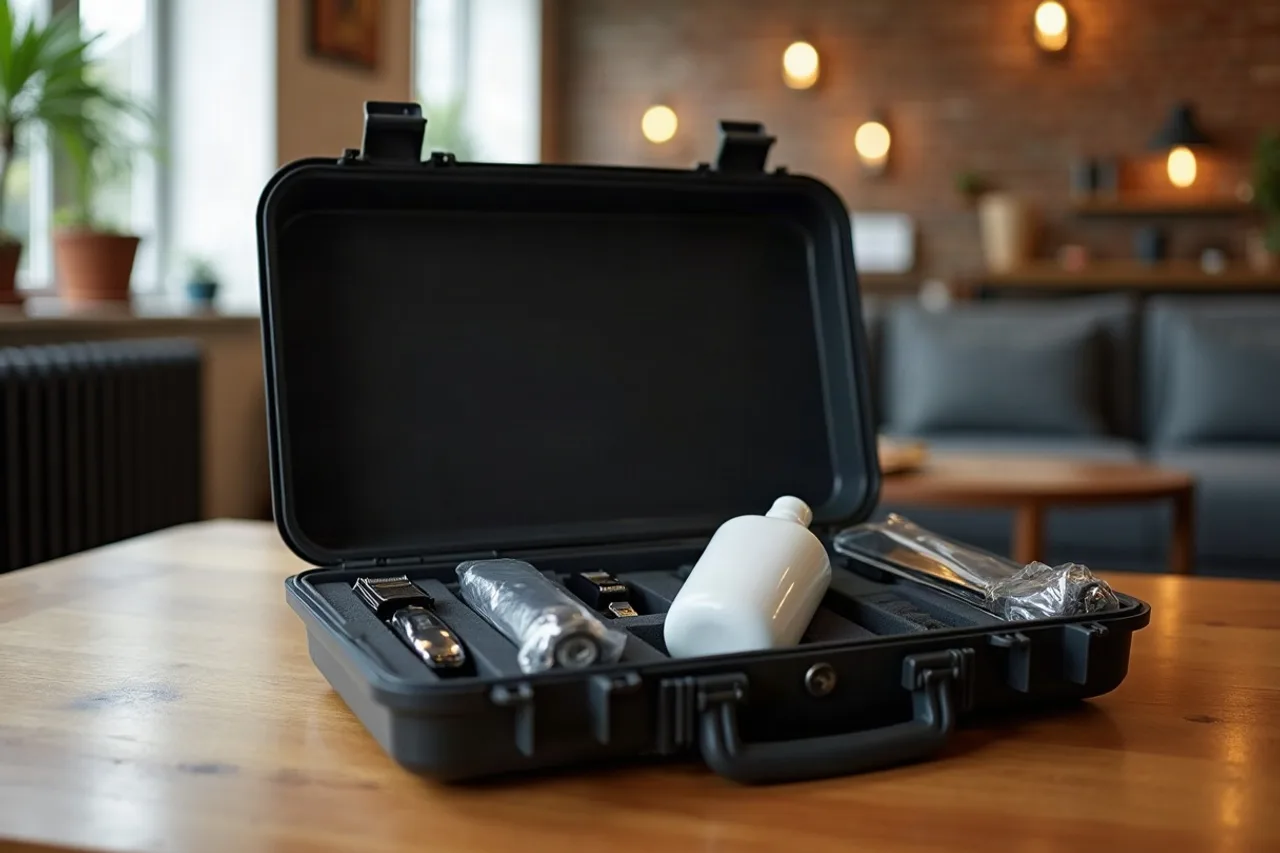
Mobile hairdresser rules: formal and sanitary requirements, what to settle before you start and how a Sanepid inspection works.
A mobile hairdresser travels to the client with a case instead of running a salon with an address. The questions you hear from friends sound similar: do you need premises for this, do I have to report anything to Sanepid (the State Sanitary Inspection), and can an inspector even come to me if I work in someone else's flat? This article answers those questions from the point of view of the person running the service: formalities, inspection and settlements. We described the hygiene kit for the road separately, in the article on the sanitary requirements for a mobile barber. Here we deal with the rest.
Key takeaways
- No premises does not exempt you from procedures. Article 16 of the Act on preventing infections requires procedures from people who carry out activities that break the continuity of tissues. What counts is the activity, not the address.
- You do not have to have a fixed place of work in CEIDG. The Act requires an address for service, and the address of a fixed place of business only if you have one.
- The inspector has the right of entry to means of transport too and may demand documents. So you carry them with you.
- Hairdressing services have no exemption from the cash register in the regulation on exemptions. Mobility does not change this, but agree the choice of device with your adviser.
- You state the price before the visit. Treat travel as a separate, transparent item.
Mobile hairdresser and mobile barber: the same business
From the point of view of the regulations there is no separate status of "mobile hairdresser". It is an ordinary business in the hairdressing sector, carried out outside fixed premises. Whether you call yourself a "barber" or a "hairdresser" does not change your obligations. Which PKD codes (the Polish Classification of Activities) to enter in the register is explained in the text on PKD codes for a hairdresser and barber.
The difference between a mobile service and a home salon is practical. In a home salon clients come to you, and in the mobile model you go to them. We describe the first case in the article on a hair salon at home.
Mobile hairdresser: formal requirements before the first trip
Before you start the on-site services, go through a short list:
- Entry in CEIDG (the Central Register and Information on Business). The application for entry is free of charge (Article 13 of the CEIDG Act). The entry includes an address for service and the address of the fixed place of business, "if the entrepreneur has such a place" (Article 5(1)(6)). If you have no premises, you do not invent a place on paper.
- Sanitary procedures. Article 16(1) and (2) requires procedures covering the way of acting in activities that break the continuity of tissues, the rules for using equipment that is sterilised, skin disinfection, and decontamination of rooms and equipment. The district sanitary inspector gives an opinion on them at your request (Article 16(3)).
- Contact with the sanitary and epidemiological station (stacja sanitarno-epidemiologiczna). The station in Iława writes on its website that hairdressing establishments are supervised by the district sanitary inspector, to whom the start of operations should be reported. We did not find a regulation that would specify a form for this notification. Ask the competent station how it works for a business without premises.
- Medical certificates for the team. If you employ someone for work on the road, check whether they have a medical certificate for sanitary-epidemiological purposes (orzeczenie lekarskie do celów sanitarno-epidemiologicznych). We describe this in the article on the Sanepid booklet for a hairdresser.
- Insurance. The civil liability insurance (OC) obligation depends on your situation. We discuss the rules in the text on liability insurance for a barbershop.
Hygiene and equipment in the field: what is different
You will find the full equipment list in the article on the mobile barber, and sterilisation "on wheels" in the text on sterilisation in the field. For order, remember three things that change when you work outside a salon:
- The websites of the sanitary stations describe rules for establishments, that is, for rooms. You carry them over into your case: you pack clean tools separately from used ones, and you label the disinfection solution with the name of the product, the concentration and the date it was prepared. That is what the stations recommend for hairdressing establishments.
- You sterilise tools that come into contact with blood at your base. You go to the client with tools in labelled pouches, not with an autoclave.
- You take the waste with you. Used blades do not go into the client's bin.
Since you have no wall with a washbasin, your washbasin is preparation. That is why it is worth keeping the documentation in a paper binder or on your phone, not in a drawer at home.
A mobile hair salon and Sanepid: a car instead of premises
More and more people convert a van into a "salon on wheels". Does that change the obligations? In the regulations we checked, we did not find a separate regime for a hairdresser who travels in their own vehicle. The obligation under Article 16 follows from the activity, not from the place, so procedures, surface disinfection and the handling of waste also apply to the inside of the car.
It is worth knowing that the Act on the State Sanitary Inspection gives the inspector the right of entry, among other places, to means of transport and facilities connected with them (Article 25(1)(1)(c)). Where there is a danger to human health, the inspector may order a means of transport to be taken out of service (Article 27(2)). Treat the car in which you serve clients like a work station: smooth, washable surfaces, a place for clean and dirty tools, and a closed waste container.
We did not check the road traffic and vehicle registration rules (for example whether a conversion requires an entry in the vehicle documents). Ask the transport department or a vehicle inspection station before you buy furniture for the car.
Sanepid and an inspection during an on-site service
The inspector may demand that documents be produced and data made available, as well as written or oral information (Article 25(1)(2) and (3) of the Act on the State Sanitary Inspection). With mobile work this matters, because you have no desk from which to take out a binder. So you carry with you:
- sanitary procedures and the disinfection and sterilisation register,
- safety data sheets of the products you use,
- the team's medical certificates, if you do not work alone,
- a template of the service terms and the client's consent.
The Act also provides for the inspector's entry into dwellings where service activity is or is to be carried out (Article 26(1)). Whether this also covers a visit to the client's flat is not settled by the text of the provision, and we do not take a position on it. Failing to implement and apply the procedures under Article 16 is a minor offence punishable by a fine (Article 50(1)). How an inspection looks in a salon is explained in the article on what Sanepid checks in a barbershop. With mobile work you will transfer this to your own conditions.
Price list and settling travel costs
We do not give amounts, because that is your calculation. It is worth setting the structure, though. The Act on providing information about the prices of goods and services requires the price to be displayed at the place where services are provided, in an unambiguous way that raises no doubts (Article 4(1)). When you give prices on a website or in an offer, the same rules apply to advertising a service together with its price (Article 4(5)). A consumer may demand that the service be performed at the price most favourable to them if the prices are unclear (Article 5). The practice that follows:
| Item | How to show it |
|---|---|
| Service (haircut, beard) | A separate price in the offer, the same for every address |
| Travel | A separate item or zones; explained before the visit is booked |
| Surcharges (evening hours, several people) | Listed in advance, not added on the spot |
| Payment | Consistent with what you wrote in the offer |
Remember about recording sales. In the Minister of Finance regulation on exemptions from the obligation to record sales on cash registers, hairdressing, beauty and cosmetology services are listed among those to which the exemptions do not apply (§ 4(1)(2)(j)). We discuss the details and the choice of a device for work in the field in the article on the cash register in a barbershop.
Frequently asked questions
Does a mobile hairdresser have to have premises?
We did not find a regulation that would require premises. The CEIDG Act requires an address for service, and the address of a fixed place of business is entered only if the entrepreneur has such a place (Article 5(1)(6)).
Does a mobile hairdresser have to report to Sanepid?
The station in Iława states that hairdressing establishments are supervised by the district sanitary inspector, to whom the start of operations should be reported. We did not find a form in the Act. Call the competent station and ask how it works for services without a fixed address.
Can Sanepid inspect a hairdresser who works at the client's home?
The inspector has the right to demand documents and information and to enter means of transport (Article 25(1)). We do not settle whether the right of entry covers the client's home. Keep your documents and procedures with you, wherever you work.
Does a mobile hairdresser need a cash register?
Hairdressing services have no exemption from recording on a cash register in the regulation of 17 December 2024 (§ 4(1)(2)(j)). We did not examine the amendment of that regulation from March 2026 or the technical requirements of a device for work in the field. Confirm them with your accountant.
Can a car be my salon?
We did not find separate sanitary regulations for a hairdresser in a car. The obligations under Article 16 concern the activity and cover the vehicle, and the inspector may enter means of transport. We did not check the rules on registering a vehicle after a conversion.
Legal status as of: 2 November 2026
Legal basis: Act of 5 December 2008 on preventing and combating infections and infectious diseases in humans (consolidated text Journal of Laws 2025, item 1675, text in ELI; Article 16, Article 50(1)); Act of 14 March 1985 on the State Sanitary Inspection (consolidated text Journal of Laws 2024, item 416, as amended, including Journal of Laws 2026, item 605; Article 25(1), Article 26(1), Article 27(2)); Act on the Central Register and Information on Business (CEIDG) (consolidated text Journal of Laws 2026, item 30; Article 5(1)(6), Article 13); Act of 9 May 2014 on providing information about the prices of goods and services (consolidated text Journal of Laws 2023, item 168; Articles 4, 5); Minister of Finance regulation of 17 December 2024 on exemptions from the obligation to record sales on cash registers (Journal of Laws 2024, item 1902; § 4(1)(2)(j)). The information on notifying the station comes from the website of the station in Iława (accessed 2 November 2026), and the information on labelling disinfection solutions from the website of the station in Środa Śląska (entry of 12 May 2025). Both are station guidance, not legal acts. We did not check: the amendment of the cash register regulation of 27 March 2026 (Journal of Laws 2026, item 420), the technical requirements of cash registers for work in the field, the road traffic and vehicle registration rules, consumer law on contracts concluded away from business premises, or the scope of the inspector's right of entry into a client's home. This text is not legal advice.
Last review: 2 November 2026
Do you travel to clients and want your papers always with you?
BarberReady gives you a complete set for on-site services: disinfection and sterilisation procedures, registers, an action sheet for cuts, and service terms and client consents. Documentation is evidence of due care, not a guarantee of the outcome of an inspection.