Hair salon at home: requirements
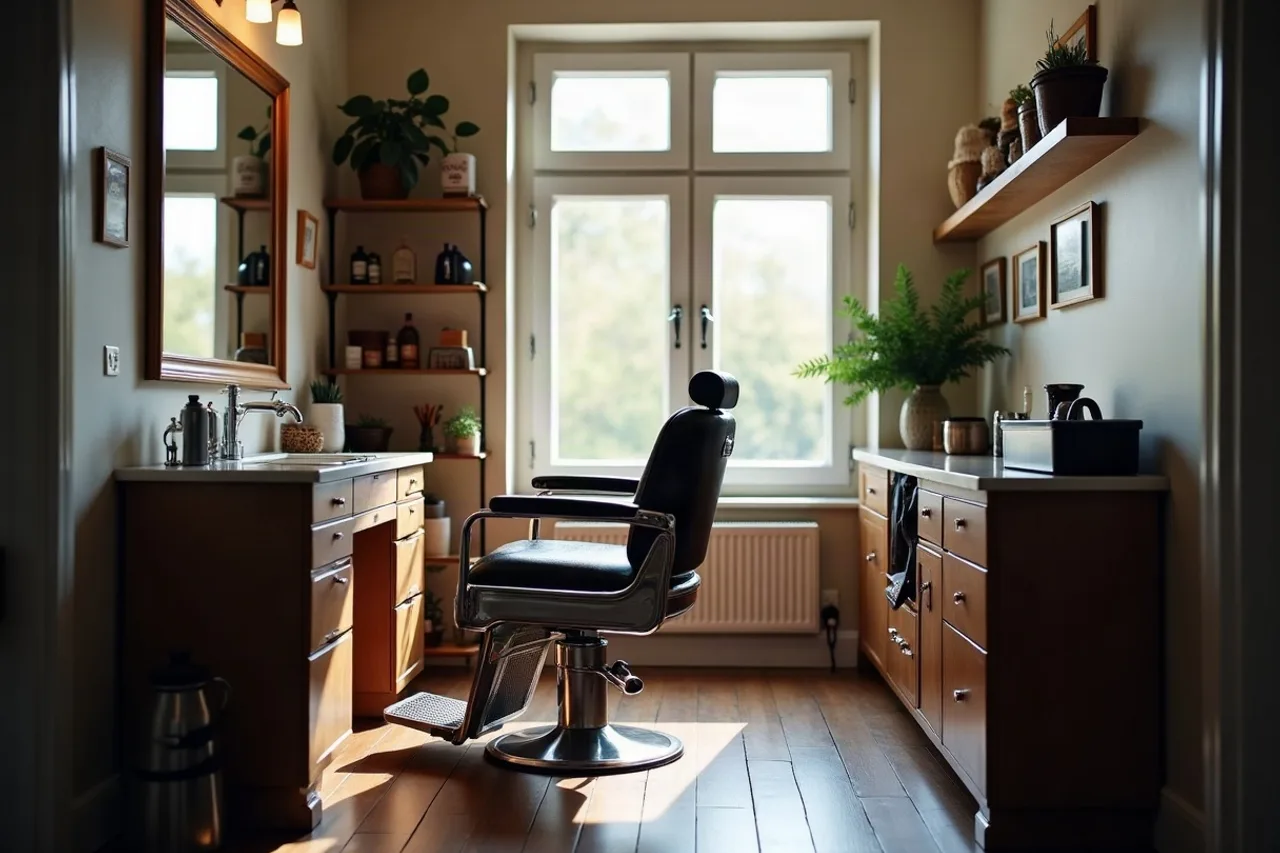
Hair salon at home: legal title to the premises, community rules, change of use, sanitary procedures and the inspector's right of entry.
You have a spare room at home, your own tools and clients who ask whether you could cut their hair "as a favour". The question of whether you can run a hair salon at home seems simple, but the answer has several layers: the right to the premises, the consent of neighbours or the housing community, building regulations, hygiene, and the fact that the sanitary inspector has special powers in such a situation. This article goes through those layers one by one. We describe the differences between a salon at home and working at the client's place separately in the article on the mobile barber.
Key takeaways
- In the provisions we read, we did not find a general ban on running a hair salon in a flat. There are conditions, however: a legal title to the premises, compliance with the housing community's rules and building regulations.
- An entrepreneur entered in CEIDG (the Polish Central Register and Information on Business Activity) must have a legal title to the properties whose addresses are subject to entry.
- If starting the business changes the hygiene and sanitary conditions of the premises, it may be a change of use, which is notified to the building authority.
- The obligation to introduce procedures protecting against infections applies to a salon at home in the same way as to a salon in commercial premises.
- The sanitary inspector has the right to enter a flat in which service activity is or is to be carried on.
Can you run a hair salon in a flat
In short: yes, if you meet conditions that come from several different provisions. The CEIDG Act itself allows you to enter the address of a permanent place of business (Article 5(1)(6)), and nothing in Article 16 of the Act on preventing infections ties the procedures to the type of room. What counts is that you perform activities during which the continuity of tissues is breached, for example shaving with a razor.
A legal title to the premises is the first threshold. An entrepreneur entered in CEIDG is obliged to hold a legal title to the properties whose addresses are subject to entry (Article 17 of the CEIDG Act). If the flat is yours, the matter is simple. If you rent it, check the purpose of the lease in the tenancy agreement and obtain the owner's written consent to run a business. You can work out the costs of such an undertaking with the rest of your budget in the article on the cost of opening a hair salon.
Consent of the community or owner and the purpose of the premises
The Act on the ownership of premises does not say directly that you may not run a business in a flat. It says something else: the owner of a unit must observe the house rules, use the common property in a way that does not hinder its use by the other co-owners and cooperate with them in protecting the common good (Article 13(1)). In extreme cases, where the owner grossly or persistently violates the house rules or makes the use of other units or the common property burdensome, the community may demand in court that the unit be sold (Article 16(1)). It is a last-resort solution, but it shows that the requirements must not be ignored.
In practice it is worth checking four things before you take your first client:
- Documents of the premises. The notarial deed, the land and mortgage register, any arrangements on the purpose of the unit.
- Resolutions and house rules. Rules on noise, traffic of strangers, use of the stairwell and the entry phone.
- The manager or the community board. A short conversation, preferably confirmed in writing.
- Neighbours. Clients come and go at set hours, but formally nobody has to agree with you for the matter to start with a complaint.
We did not check the local spatial development plan or the specific provisions of notarial deeds. Those documents are different for every building.
Change of use of the premises
The Construction Law defines a change of use of a building or part of it, among other things, as starting or ceasing an activity that changes the conditions of fire safety, work, health, hygiene and sanitation, environmental protection, or the size or layout of loads (Article 71(1)(2)). Such a change must be notified to the architectural and building administration authority before it is made. The notification is accompanied, among other things, by a certificate of conformity of the intended use with the local spatial development plan or a decision on development conditions, and, for a change affecting the conditions mentioned above, also a technical expert opinion prepared by a person with building qualifications (paragraph 2, points 4 and 5).
Is a single hairdressing station in a room of a flat a change of use? We will not decide that for you. It depends on the scale, the layout of the premises and the authority's assessment. So before the conversion, ask the office or an architect rather than assuming the answer.
Sanitary requirements for the room
The former Minister of Health regulation of 17 February 2004 on detailed sanitary requirements for hairdressing, beauty, tattoo and wellness establishments no longer applies (in the Sejm's ELI database its status is "not in force - legal basis repealed"). Article 16 of the Act on preventing infections requires procedures, not a specific floor area or a list of materials. The procedures are to regulate how activities breaching the continuity of tissues are carried out, the rules for using equipment that is sterilised, and the disinfection of skin and mucous membranes and decontamination of rooms and equipment (paragraph 2).
In practice it is your procedures that describe what the clean and dirty zones look like in the room, and it is those that the inspector will look for in the room. Below are our practical tips, not requirements from the legislation:
- A separate room or a clearly separated zone. Do not provide services in a place where the family eats every day.
- Washable surfaces. A worktop, a floor and a chair or armchair that can be disinfected.
- Access to water and a hand-washing basin. The bathroom in the flat should not be the only place for washing hands and tools.
- A place for sharps waste and dirty linen. Closed, out of reach of household members and animals.
- Separation from home life. Animals, children and private belongings outside the work zone.
If you employ someone, occupational health and safety (OHS) rules for workrooms start to apply. We discuss the requirements for volume and floor area in the article on the premises requirements for a barbershop. How to lay out zones in a small room is described in a separate article on arranging a salon with Sanepid in mind.
Notifying Sanepid and the scope of inspection
In Article 16 of the Act on preventing infections we did not find an obligation of a separate notification or acceptance of a hairdressing establishment before it starts. We did not search all acts, however, so it is worth confirming the local expectations of the station (Sanepid, the Polish sanitary inspectorate) by phone. At the request of an entity obliged to introduce procedures, the district state sanitary inspector gives an opinion on them (Article 16(3)). More on contact with the station in the article on notifying a salon to Sanepid.
A salon at home has one feature that distinguishes it from commercial premises. The state sanitary inspector has the right to enter flats in case of suspected or confirmed infectious disease, a threat to health from environmental factors, and also if production or service activity is or is to be carried on in the flat (Article 26(1) of the Act on the State Sanitary Inspection). In other words, a flat is not an exception to inspection.
An inspection of an entrepreneur usually begins with a notification of the intention to start it, and the inspection itself is started no earlier than 7 days and no later than before 30 days have passed from the delivery of the notification (Article 48(1) and (2) of the Entrepreneurs' Law). No notification is made, among other cases, when the inspection is justified by a direct threat to life, health or the environment (paragraph 11, point 4). What the inspector checks on site is described in the article on a Sanepid inspection of a barbershop.
Documents you must have on site
For a salon at home the list is the same as for other salons, but here it is especially important that everything can be seen "in your kitchen". The minimum worth having written down and available:
- a procedure for disinfecting and sterilising tools (with what, how, how often),
- a procedure for keeping the room and the station clean,
- handling of waste, including sharps,
- a procedure in case a client is cut,
- a disinfection register kept up to date,
- information on the client's personal data and consents where needed,
- staff documents, if you employ anyone.
A set of procedures, registers and consents that can be adapted to a single station is in the Foundation package. The cash register applies to you in the same way as in commercial premises, because hairdressing services are not covered by the exemption (section 4(1)(2)(j) of the Minister of Finance regulation of 17 December 2024). Details are in the article on the fiscal cash register in a barbershop.
A salon at home versus a mobile hairdresser: differences
| Feature | Salon at home | Mobile hairdresser |
|---|---|---|
| Where you work | in your own premises, the client comes to you | at the client's place or at an event venue |
| Address in CEIDG | address of a permanent place of business | address for service, there may be no permanent place |
| Community and building rules | apply to your building and your unit | do not apply to your unit, because you do not receive clients at home |
| Hygiene facilities | you have them permanently | you must carry them in a backpack |
| Inspector's entry to a flat | Article 26(1) of the State Sanitary Inspection Act expressly mentions a flat in which service activity is carried on | applies to the flat where the activity is carried on; we did not examine entry to clients' flats |
Both forms have the same core: infection procedures and equipment that can be prepared safely. What differs is the place and the responsibility for it. You will find the details of working in the field in the article on the requirements for a mobile barber.
Frequently asked questions
Can I run a hair salon in a flat?
In the provisions we read, we did not find a general ban. You must have a legal title to the premises (Article 17 of the CEIDG Act), observe the house rules (Article 13 of the Act on the ownership of premises) and check whether there is a change of use (Article 71 of the Construction Law).
Do I need the consent of the housing community?
The Act on the ownership of premises does not directly introduce a requirement of consent for a business, but it obliges the owner to observe the house rules and not to interfere with other owners. Check the provisions of your particular community in its resolutions and in the documents of the unit. A tenant should have the owner's consent.
Does a salon at home have to notify Sanepid?
In Article 16 of the Act on preventing infections, which we checked, we did not find a separate notification obligation. You must, however, introduce procedures protecting against infections and expect an inspection. You can apply to the district sanitary inspector for an opinion on the procedures (Article 16(3)).
Can the inspector enter my flat?
Yes, if service activity is or is to be carried on in the flat. Such entry is provided for in Article 26(1) of the Act on the State Sanitary Inspection. As a rule, an inspection is preceded by a notification, with the exceptions described in the Entrepreneurs' Law.
Do I need a fiscal cash register in a flat?
Yes. The exemption from recording sales on a cash register does not apply to hairdressing services, regardless of where they are performed. What matters is the type of service, not the address.
The articles on the cash register, the PKD and start-up costs complement this description. If you are starting from scratch, first open the article on the PKD code for a hairdresser and barber. You can check the Construction Law provisions in the consolidated text in the Journal of Laws, and the powers of the sanitary inspectorate are described on the website of the Chief Sanitary Inspectorate.
Legal status as of: 2 November 2026
Legal basis: CEIDG Act of 6 March 2018 (consolidated text Journal of Laws 2026, item 30; Article 5(1)(6), Article 17); Act of 24 June 1994 on the ownership of premises (consolidated text Journal of Laws 2026, item 232; Article 13(1), Article 16(1)); Construction Law of 7 July 1994 (consolidated text Journal of Laws 2026, item 524; Article 71(1)(2) and (2)); Act of 5 December 2008 on preventing and combating infections and infectious diseases in humans (consolidated text Journal of Laws 2025, item 1675; Article 16); Act of 14 March 1985 on the State Sanitary Inspection (consolidated text Journal of Laws 2024, item 416; Article 26(1)); Entrepreneurs' Law of 6 March 2018 (consolidated text Journal of Laws 2025, item 1480; Article 48(1), (2) and (11)); Minister of Finance regulation of 17 December 2024 on exemptions from recording sales on cash registers (Journal of Laws 2024, item 1902; section 4(1)(2)(j)). We did not check the local spatial development plan, notarial deeds and community resolutions, technical conditions for buildings, local taxes on premises used for business, tenancy law or the changes to the Construction Law from July 2026. Whether a particular station in a flat constitutes a change of use is decided by the authority, not by this text. This text is not legal advice.
Last review: 2 November 2026
Starting a salon at home and want procedures written down from the first client?
BarberReady gives you a complete set of disinfection, sterilisation and hygiene procedures that you can adapt to a single station at home. You have written rules an inspector may ask about, and you know what to complete next in your own room.